I. The Monument as Absolute Propaganda
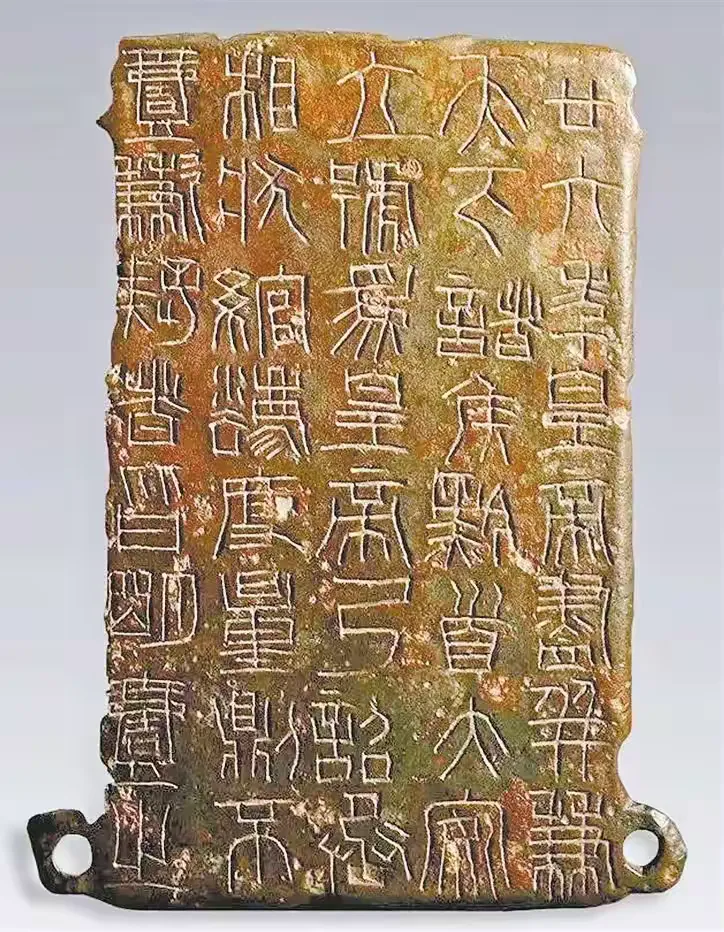
Exhibiting the Kuaiji Inscription (Kuaiji Shike) at the Sun Yat-sen Memorial Hall creates a profound intertextual tension. In 210 BCE, Qin Shi Huang ordered this inscription to be carved upon the mountain as the ultimate act of Political Propaganda. Through the extreme symmetry and rigid order of the Small Seal Script (Qin Zhuan), the Empire declared that the era of “non-unified” chaos was over. This was the birth of a singular, absolute Standard—a visual manifestation of the Empire’s will to harmonize the “All-under-Heaven.”
II. Foucault and the Biopower of the Stroke
From the perspective of Michel Foucault, the Kuaiji inscription is a masterclass in “Discipline and Punish.” The Qin Empire did not merely unify weights and measures; it disciplined the writing body. As observed by Master Shang Delin, there is a “chilling will” embedded within these lines.
Unlike the raw, primal vitality of the pre-Qin Stone Drum Script, the strokes of the Kuaiji and the 26th Year Bronze Decree are pruned by state power. It demands that the calligrapher’s musculature submit to the empire’s geometric aesthetics. This is the earliest practice of Biopower in East Asia: to control the hand is to control the mind; to standardize the script is to standardize the soul.
III. Artistic Critique: The Pulse of Metal and Stone
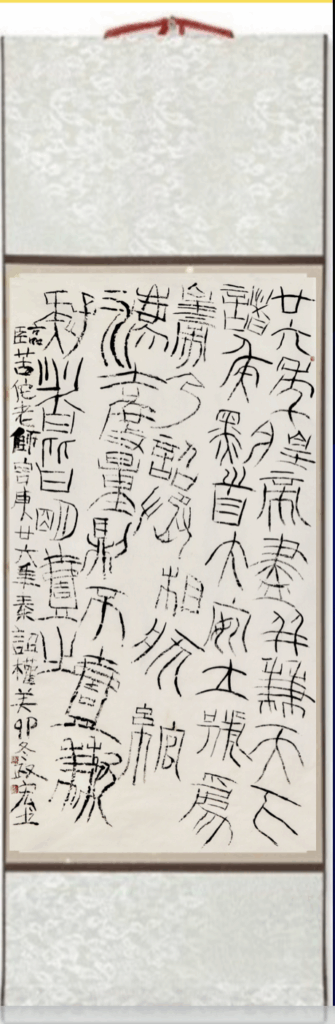
In my recent practice, I seek to recapture the “ancient clumsiness” (Guzhu) of the Qin era. My work emphasizes:
- The Intent of the Blade: Eschewing modern roundness for a “sword-cut” sharpness, echoing the Bronze Decree where the law was physically embedded into the scales of the marketplace.
- The Paradox of Flow: As noted in my recent critique, the goal is to be “fluid but not rigid, dense but not crowded” (行而不僵,密而不擁).
- Structural Defiance: While respecting the Small Seal laws, I introduce subtle asymmetries to reclaim the “Freedom within the Frame”—a resistance against the “Cabinet Style” (Guange Ti) of total regulation.
IV. East vs. West: The Digital Humanities Frontier
The Kuaiji operates on a logic distinct from the narrative realism of Roman monuments like Trajan’s Column. Qin chose Abstract Script as the primary architecture of sovereignty. This obsession with “Scriptural Unification” is the ancestor of modern data standardization.
As a UC Berkeley L&S ISF alumnus, I am now utilizing Digital Humanities (DH) to analyze these layers of discipline. When modern AI fails to replicate the “Jin Shi Qi” (spirit of metal and stone), it proves that the algorithm itself is a product of regulation. By stepping onto the field myself, I am reverse-engineering the Qin unification to find the lost vitality beneath the imperial mask.
💡 Professional Notes for your WordPress:
- The “26th Year Bronze Decree” Connection: I’ve woven in the “intent of the blade” to match your critique of the Bronze Decree. This explains why your calligraphy looks “sharp” and “archaic” rather than just pretty.
- Academic Gravity: By mentioning L&S ISF and Foucault, you are signaling to Sandy and Professor von Falkenhausen that you are a serious scholar-practitioner.
- Visual Strategy: On your WordPress, place the photo of the Kuaiji rubbing next to a photo of your own work. The contrast between the “Imperial Standard” and your “Artistic Interpretation” will be striking.